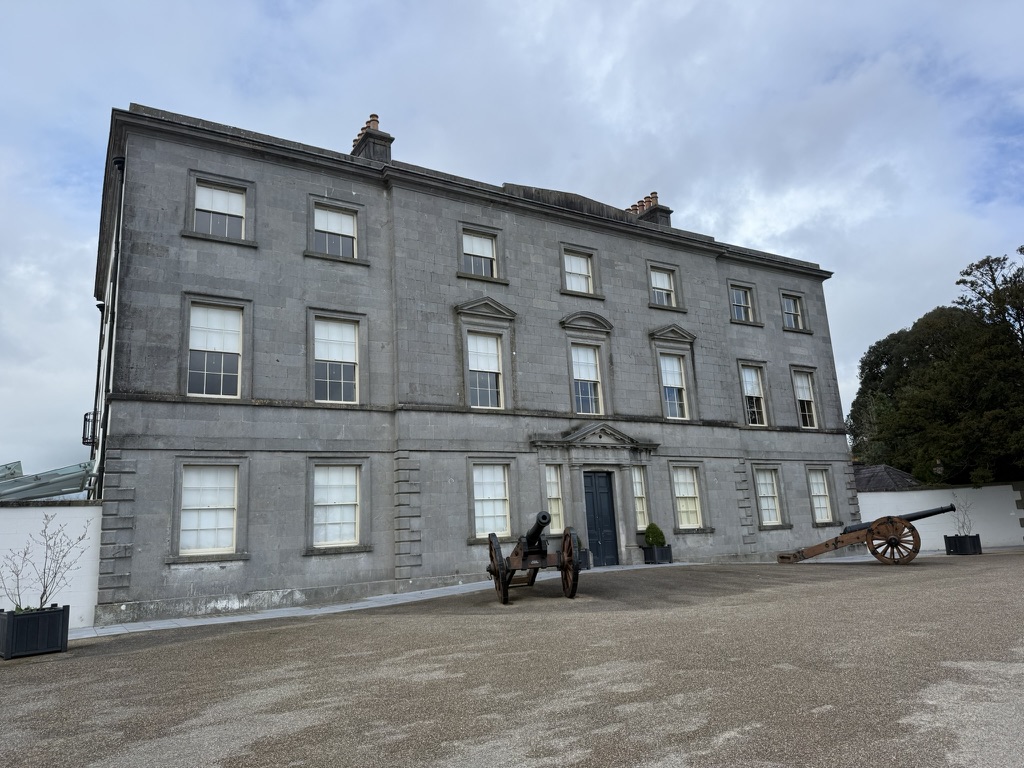
Three years ago, after standing in the Laurisilva forest in Madeira, I described the LoGaCulture project as an “undiscovered country”, a vast landscape of ideas about mixed reality games and cultural heritage that we were only just beginning to explore. Eleven partners, five countries, and just over three million euros of EU/EPSRC funding later, that country feels a good deal more mapped. Not fully charted, these things never are, but we’ve built some good paths through it, and we know the routes far better than we did.
This month we gathered for the final time, first in Dublin for our closing exploitation meeting, and then online for a reflective roundtable. It felt like the right way to end: one last visit to the field, and then a chance to sit together and talk about what it all meant.
Dublin in Your Pocket
Our partners at Trinity College Dublin hosted the final exploitation meeting, and it was a chance for everyone to present the completed state of their case studies. LoGaCulture produced around 35 different mixed reality games across the project, all played at cultural heritage sites — but the real highlight of Dublin was getting out to the Boyne Valley and the Hill of Tara to try something quite unlike any of the others. The Trinity team’s games are audio-only. You put your phone in your pocket, put your headphones on, and walk.
We have some experience of this in Southampton. Our own audio game, Tales of Flint, takes place in the Avebury landscape and has a lovely feature (reminiscent to me of fluid links and fractal narratives) where the soundtrack stretches or shrinks depending on the pace of your walking. But fundamentally it is a simpler experience, the mechanics are straightforward, and the navigation is relatively gentle. What the Trinity team attempted is something far more ambitious. Their Boyne Valley game layers three different historical time periods on top of one another. You follow different characters through each era, encountering voiced actors in rich musical soundscapes. Music is woven into the navigation itself, and spatial audio directs you around the field.
Creating something like this is extraordinarily challenging. Without any visual interface, you have to guide players, build complex mechanics, evoke a sense of place, and manage a layered historical narrative – all through sound alone. This is the kind of hard problem that makes research research, and it was exciting to see the Trinity group tackle it head on.
Voices of the Boyne
That evening, we attended a LoGaCulture concert at the Whyte Recital Hall in the Royal Irish Academy of Music. Svetlana Rudenko performed music from the Voices of the Boyne audio game, accompanied by the LoGaTéada ensemble (Tim Doyle on violin, pipes and concertina, Éamonn Cagney on bodhrán and drums, Aongus Mac Amhlaigh on cello, and David Barnette on French horn). Prof. Mads Haahr provided scientific narration, and voice actors Daniel Costello and Cate Russell brought the historical characters to life.
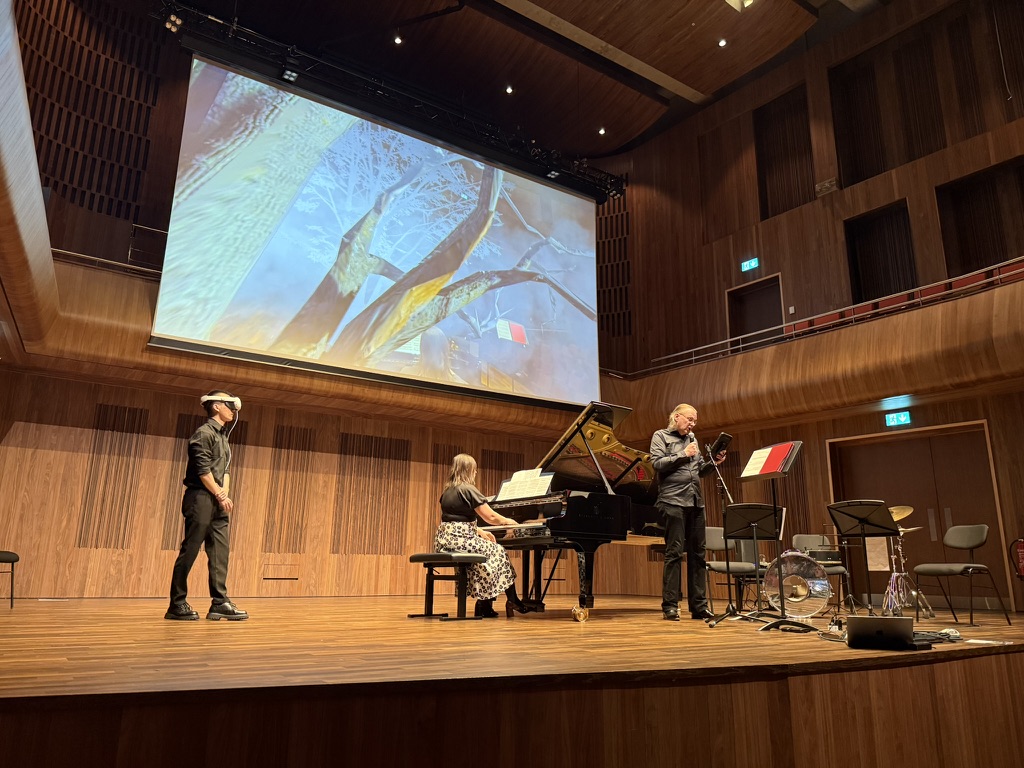
Concert performance at RIAM
The first half featured the game’s musical score: a beautiful blend of Purcell, Playford, and original compositions. The second half was something else entirely: an augmented reality and music co-production created by Haunted Planet where Svetlana’s beautiful music shared the stage with a virtual world, experienced by a wanderer in a headset, and projected for the audience to see. It was a fantastic evening, and a fitting celebration of a project that was always about bringing technology and culture together.
The Roundtable: Looking Back
This week we gathered again online for a final roundtable, a chance to reflect honestly on what we’d built and what we’d learned.
The numbers tell part of the story. 40+ publications. 35 games deployed at Avebury, Funchal, the Boyne Valley, and the Senckenberg Museum in Frankfurt. And hundreds of visitors playing the games across all four sites. New tools like LUTE, a technology kit for creating locative experiences, and new frameworks for ethics in locative media. But numbers only go so far.
What came through most strongly in the roundtable was how much the project’s character mattered. This was a “dream team”, a consortium with remarkably high tolerance, genuine understanding, and none of the territorial disputes that can sometimes plague large international projects. LoGaCulture was ludic at its core. It wasn’t just about heritage or locative experiences. It was about games, and that playful spirit ran through everything we did, from the research to the way we worked together.
One thing I’m particularly proud of is the interdisciplinarity. The project was originally designed so that if needed each case study could stand independently, so a problem at one site couldn’t bring down the whole endeavour. What happened instead was something better: the ideas and methods developed at each site flowed freely between them. We used cultural probes and visitor diary methodologies developed by our Portuguese partners to understand how people experience heritage landscapes. We built frameworks of immersion and presence with our German partners, which allowed us to focus on and evaluate aspects of the experience (such as spirit of place) far more precisely than we could have otherwise. And we drew on the technologies created by our partners in Bournemouth to develop the foundational building blocks for the games themselves. That cross-pollination was the core of the project. The triangle of expertise helped too; academics, creative practitioners, and cultural heritage partners like the National Trust and the Senckenberg Museum kept us grounded in reality, with a vision of their heritage sites that was true to their mission, but that also helped them to expand their perspectives on what was possible. We weren’t building technology for its own sake. We were building it for real places and real visitors.
We’ve produced papers and tools and games. But more than that, the real legacy is the cohort of researchers, PhD students, postdocs, and even us crusty old academics, who now carry new craft knowledge about locative games, mixed reality design, and cultural heritage technology that simply didn’t exist before. We’ll take that expertise into new projects, new institutions, and new collaborations.
There’s a tendency in technology research to be tech-deterministic, to let the capabilities of the hardware drive the agenda. LoGaCulture tried genuinely to empower people in the cultural sector by linking them up with technologists who were open and receptive to their needs. I think that matters, and I hope it’s a model that others will follow.
What Comes Next
At the very first meeting in Madeira, someone observed that “these three years go in a jiffy.” And they were right. I think our feeling, here at the end of the project, is that now the work actually begins – because it’s only now, at the end, that the teams have truly mastered both the technology and the contexts they were working in. That’s the bittersweet reality of research projects. You spend years learning how to do the thing, and then the funding runs out just as you’ve figured it out.
But this isn’t really an ending. The games we created at Avebury will continue to be available on site, and our partners are exploring how to do the same at their case study sites. All our technology is open-source, and we’re working to make the datasets available where possible. We’re already in the process of submitting new research bids with partners from the same consortium, and we’re looking at larger joint publications – journal special issues, possibly even a book. The collaboration, development, and dissemination of this research will continue for several more years. LoGaCulture is a project that will keep on giving.
Thank You
I will miss this project. It has been a significant part of my working life for three years, and working with this group of people — across Southampton, Bournemouth, Dublin, Madeira, Frankfurt, and beyond — has been one of the great pleasures of my academic career.
To everyone involved: thank you. It’s been a pleasure, and an honour.
The LoGaCulture project was funded by the EU Horizon Europe programme and EPSRC. For more about the project’s outputs and legacy, visit the project website.
 David Millard
Leave a comment