
Last year I played the excellent whodunnit RPG Disco Elysium by ZA/UM. It’s already become something of a classic due to its a genius take on an RPG engine, as the four core abilities of the player character (Intellect, Psyche, Physique, and Motorics) manifest through twenty sub-skills, each of which is effectively an aspect of your character’s personality. Throughout the game you will make skills checks against these aspects, but they will also provide an internal monologue – narrating your game according to the way that your character develops. Coupled with the Thought Cabinet – a psychological soup of political, personal, and philosophical ideas that you gather as your progress and which acts as collectable gear for the mind – they set the unique tone of the game. Exploring the mind and character of the main protagonist is as much the focus of Disco Elysium as the murder that you are nominally in Revachol to solve.
Like many open narrative games, Disco Elysium is effectively a sculptural hypertext (with storylets anchored on points of interaction, such as NPCs and items like doors and cupboards) but where each of the storylets is a mini-adaptive hypertext. So for example, clicking on Measurehead – an imposing Übermensch guarding the entrance to the harbour office – will initiate a dialogue on his twisted and immutable racial theory, which you can navigate in the usual way be selecting options within a dialogue tree.
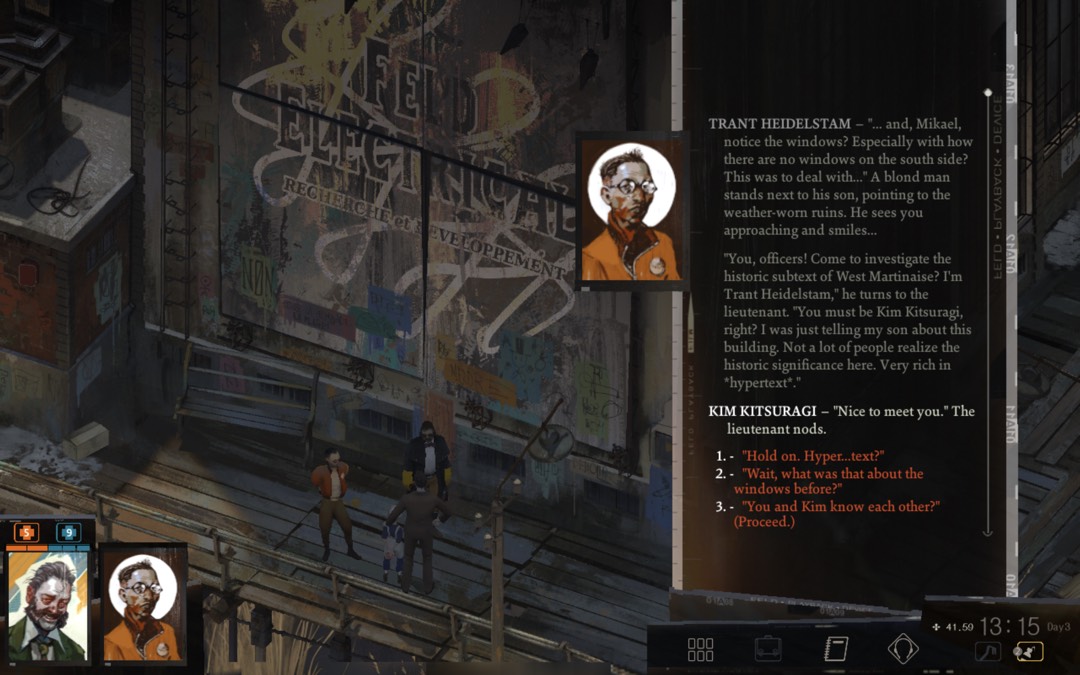
I’m not sure that philosophical arguments with racial supremacists was exactly what the early hypertext researchers had in mind, but otherwise these interactions are classic adaptive hypertexts. Perhaps the developers had this in mind during this conversation with Trant Heidelstam – special consultant to Revachol Citizens Militia – “rich in hypertext” indeed.
Certain choices within these trees will resolve differently based on a skills check, effectively an adaptive outcome based on a probabilistic check against the user model. However, in classic hypertext systems this mechanism is hidden from the reader. Disco makes the calculation scrutable, showing you the number you need to exceed on a virtual d20 dice roll, and classifying it as a Low, Medium, or High chance. For example, in the scene with Meathead you have the option to sign up to his ideology (giving you a new thought for your cabinet), but it requires a Conceptualisation check – and the game gives you all the stats including your percentage chance of success. In addition checks are colour coded, those that can be retried are white, but those that are one-chance-only are red.
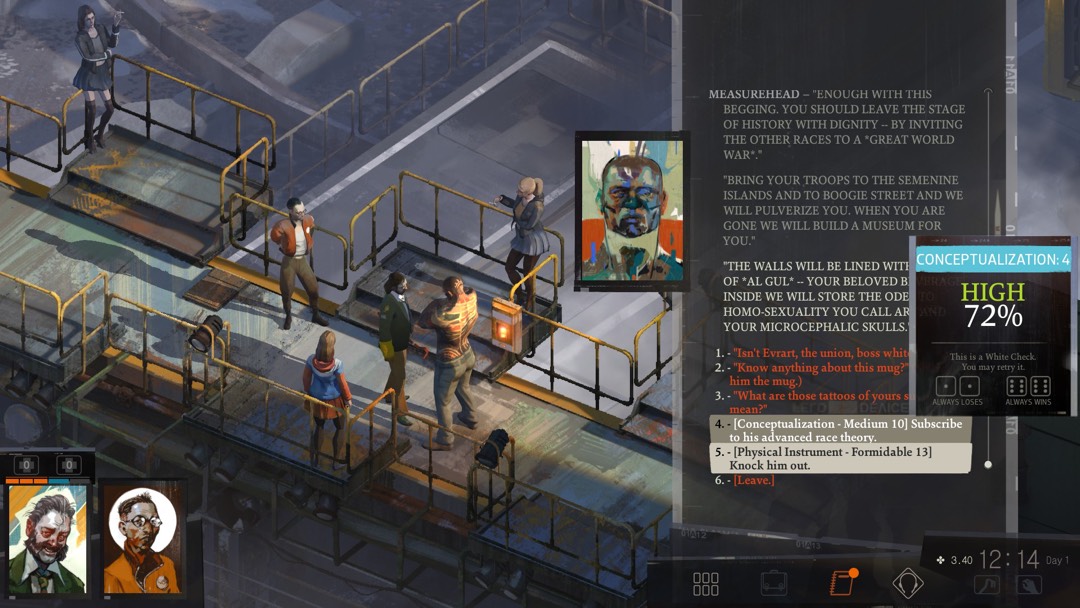
I suspect this was an aesthetic decision as much as anything else, as it gives Disco the feel of a tabletop RPG, and according to the developers the game has its roots in a tabletop campaign setting. But this scrutablility also gamifies the adaptive system and increases player agency, as they become aware of risks (the red checks) and are informed about paths they can not yet take because their abilities are too low, creating ad-hoc goals (to raise those stats, and try again). In adaptive hypertext there was always the concept of scrutable user models (so that you can see what the system thinks of you, and correct it if necessary) but I don’t recall the mechanism itself ever being this visible. Other games go down this route to a certain extent (for example, even Mass Effect labelled some of its choices as Paragon or Renegade, to show that your user model enabled them), but Disco is the most transparent that I can recall.
It’s a minor point, about an amazingly deep and cerebral game that is so much more, but it is an interesting example of how relatively minor changes to the presentation engine of a hypertext can create ludic rather than readerly experiences.
If you haven’t already, play Disco Elysium. It’s a work of art.

 David Millard
Leave a comment