I love a good RPG, but as someone who grew up with PC gaming (ok, ok, it might have been Commodore 64 gaming, but who’s counting a few bits) I missed out on the JRPG experience. Final Fantasy was massive on the NES, but I was busy playing the original Bard’s Tale, and then the TSR SSI games (fantastic titles such as Pool of Radiance, Curse of the Azure Bonds, and then Eye of the Beholder on the Amiga). Just a bit more recently I discovered that the Witcher 3 on the PS4 was actually the best game of all time. Seriously. No arguing.
Re-releases have given me the opportunity to try out a few JRPGs since (the Final Fantasy series on iOS is surprisingly good), but I never took on a current-gen JRPG until this year, when stellar reviews of Persona 5 (published by Atlas), and the praise heaped on its social storytelling, persuaded me to give it a go.
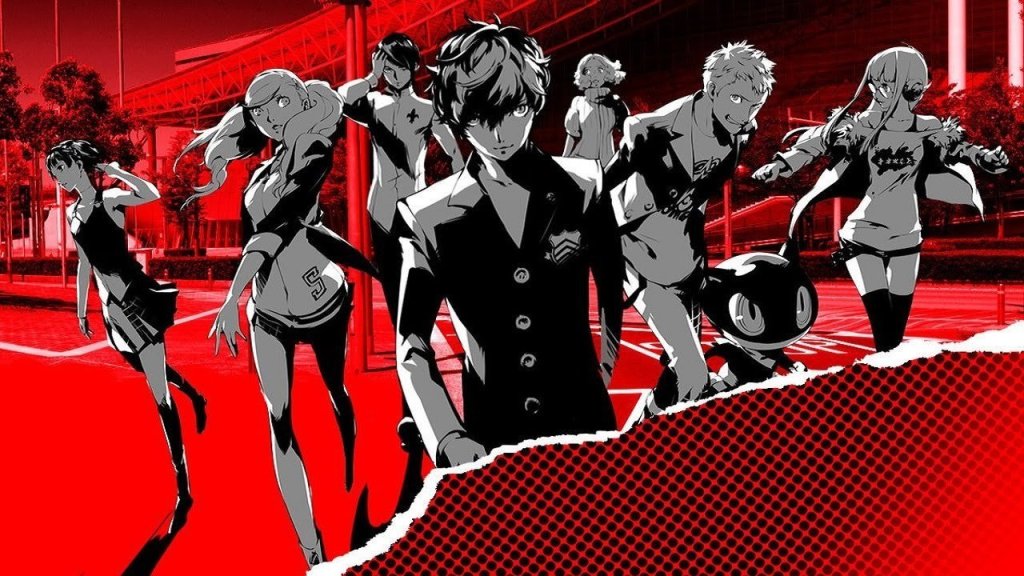
Persona 5 is a massive game, and given that it’s essentially a turn-based combat mini-game embedded in a social sim, it’s amazing that it holds the player’s attention for its full 100 hour playtime – but it just about pulls it off. There are some some real highs too – an amazingly acid jazz soundtrack, a startling visual style, an interesting set of mechanics based around the titular personas, and a narrative that is not afraid to go dark when necessary. Unfortunately there are also some lows – including a very poor depiction of gay characters, inconsistent graphics quality, and not to mention that it’s around 30 hours too long.
I found it fascinating how Persona 5 handles narrative (no major spoilers ahead). The game is structured around a year in the life of a Tokyo schoolboy. Each day is broken down into a number of time slots, some of which require you to do certain things (such as attend school), while others are free for you to manage your time with activities that you choose. Social interactions (from hanging out with friends to doing minor jobs around Shibuya) increase your stats, which help you out when you enter palaces – the game’s equivalent of a dungeon – and which can also unlock new areas and branches of the narrative.
As the year progresses, the story unfolds. Certain challenges are laid down that must be completed before certain dates, and a series of bosses and their palaces must be defeated before the final twists and turns of the narrative conclude. Turns out those reviewers were right. The story is excellent, told partially in flash forward (for around half the game you play in the past), and linked together through a vast array of scripted encounters, cutscenes, and anime.
As an interactive narrative what I found most interesting was how Persona 5 handles agency. Narrative games have to deal with something called the Narrative Paradox, which is the problem that if you allow players to do what they want they might choose something that is inconsistent with the story. If Peter Rabbit decides to listen to his Mother, then Beatrix Potter’s near death adventure becomes an afternoon picking blackberries. Games have a variety of ways to manage the impact of agency, ranging from a light touch to a heavy hand. So for example, we might map different techniques to different types of agency as follows:
| Full Agency | Topology (Open Worlds) – use landscapes at the edge of maps to limit travel.
Normal Game Mechanics – players are limited only by the games mechanics |
| Influenced Agency | Direction – use visual cues to suggest actions (“look! a treasure chest”)
Topology (Encourage) – use landscape/environment to suggest paths and interesting destinations |
| Partial Agency | Control (Quick Time Events) – briefly change the mechanic to limit agency for a particular decision
Patterns (Split/Joins) – use the structure of the narrative to manage branches (i.e. return divergent paths to a common place) Patterns (Mirrorworlds) – mirror the structure of the narrative, so that the same events unfold, but with a specific difference (i.e. a different NPC alongside the player) Topology (Restrict) – use the landscape/environement to bar the way (e.g. a door that only opens at the right point) |
| False Agency | Illusion of Choice – give the player a cue that they have taken an important decision even when they haven’t (“Clementine will remember that”)
Agnostic Characters – allow the player to make extensive character design decisions, which have no effect on the story. |
| No Agency | Control (Cut scenes) – take control away from the player and make an important decision in a non-interactive cut scene |
In general I would say that all of these methods work. Some very fine games make extensive use of cutscenes for example (I’m looking at you Metal Gear), and Telltale’s wonderful narrative games depend strongly on partial agency techniques, as well as the illusion of choice. But if you can, giving the player something closer to full agency will mean that they are more invested in the decisions, and experience the story actively rather than passively.
On first glance Persona 5 doesn’t seem to use any of these methods. Your decisions matter and appear to have real effects, the world is genuinely open with few topological restrictions (other than the discovery of new areas, but that is also driven by the player), and as far as I could tell the choices are real branches – splits, but no joins.
And yet Persona 5 delivers a grand narrative. As the days pass you effectively experience a mystery adventure, with plot revelations, twists and betrayals, and proper pacing. How does it achieve this?
I think it does it using two techniques that I had not really thought about before (although they have definitely appeared in previous Persona games, so perhaps they are more established than I realise).
- Time (Influenced/Partial Agency): Many games link spatial progress to narrative progress. Story as journey. As you move through the levels or locations the story unfolds, triggered by each new location. This is listed above as Topology (Encourage), and Topology (Restrict). Persona 5 does the same thing, but with time. In particular the calendar that is always ticking forwards, triggering world events, and counting down to clearly signposted events. Play therefore unlocks narrative, despite the absence of levels, in a technique we might call Time (Restrict). Also the player is encouraged to prepare for climactic events with a heavily emphasised countdown, which we might call Time (Encourage).
- Agency Misdirection (False Agency): Just as a magician draws your attention to his right hand as he swipes your watch with his left, so Persona 5 misdirects the awareness of your agency away from the grand narrative, leaving you with the feeling that your choices have consequences, while in fact they have little or no impact. In Persona 5 all of your agency is in the social sim. It’s up to you which Confidents you build, which romances you unlock, whose personal story you explore – but the only impact this has on the grand narrative is to provide you with new abilities or skills. The grand narrative is completely linear. In fact there are places where this creates friction – such as an NPC behaving slightly out of character in the grand narrative scenes – but the fact that its noticeable is really testament to how well they are developed elsewhere.
When I thought more about Agency Misdirection I realised that I had seen it before, but not done with such aplomb. In Horizon: Zero Dawn by Guerrilla Games (or as everyone thinks of it to themselves: The Robot Dinosaur Game) Aloy explores an apparently open world, undertaking whatever quests that the player discovers and wants to pursue. Just like the Witcher 3, some quests move the grand narrative forward, while other side quests let you explore the world and build your experience and equipment. Unlike the Witcher 3 the grand narrative quests are almost entirely linear (there is some limited choice about order) and there are no alternative endings. However, the side quests will give you allies, and these NPCs appear (or not) at the climatic battle at the end of the game to give you aid.
So HZD is really using the side quests as agency misdirection, you can chose the order, chose to do them or not, even make choices that impact how those micro-narratives end (some of they are non-linear), but there are no large scale narrative consequences to your actions, and no interplay between those quests.
In HZD this does work, but feels a bit of a cheat. It doesn’t really matter how you play, or what you do, the bigger picture story pans out in the same way. Persona 5 manages to get away with it more successfully because the social aspects of the game are such a big and important part of the experience. In HZD you do the side quests to build your character and make it possible to tackle the grand narrative quests, in Persona 5 you play the social game because its as much the point of playing as progressing the grand narrative. In fact its probably as fair to say that the grand narrative exists to give the characters an interesting social context, as it is to say that the social game exists to help you build your experience and succeed in your adventuring. That’s a tricky balance, but if you’ve ever been part of a fandom with a shipper community then you will know that its something that can be enormously appealing when its done right.
And this is probably the real triumph of Persona 5. A balance between a social game with full/influenced agency, and a grand adventure narrative with false agency, that together immerse the player in the social interactions of appealing characters in difficult and interesting situations.
It’s Buffy the Bard’s Tale in Tokyo – and you know, I like all three of those things.

 David Millard
Leave a comment